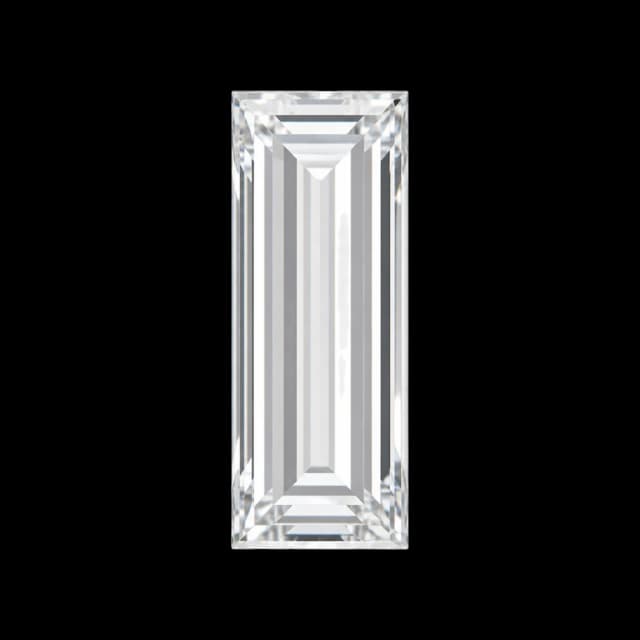
Baguette Diamond
The baguette is a narrow, elongated step-cut diamond with sharp 90-degree corners and minimal faceting. It is the most common side stone in fine jewelry, prized for its clean, architectural look that complements virtually any center stone shape.
Is a baguette diamond a good choice?
Baguette diamonds are known for low brilliance with 14 facets. They're popular for side stones in three-stone rings and channel-set wedding bands. Here are the trade-offs.
Why people love it
- +The most versatile side stone. Pairs with virtually any center shape.
- +Clean, architectural aesthetic that never looks dated
- +Very affordable compared to brilliant cuts
- +Creates elegant geometric patterns in channel settings
- +Low profile sits flush and won't catch on clothing
Things to know
- −No sparkle or fire. Designed for clean elegance, not brilliance.
- −Inclusions are highly visible. VS2 clarity minimum.
- −Rarely suitable as a standalone center stone
- −Color shows more than in brilliant cuts. H or better recommended.
How big is a baguette diamond? (MM to carat)
A 1-carat baguette diamond measures approximately 8 x 4 mm. Here are the most common sizes from 0.25 ct to 5 ct.
| Carat Weight | Size (mm) |
|---|---|
| 0.25 ct | 5 x 3 mm |
| 0.33 ct | 5.5 x 3 mm |
| 0.5 ct | 6.5 x 3.5 mm |
| 0.75 ct | 7.5 x 4 mm |
| 1 ct | 8 x 4 mm |
| 1.25 ct | 8.5 x 4.5 mm |
| 1.5 ct | 9 x 5 mm |
| 2 ct | 10 x 5 mm |
| 2.5 ct | 11 x 5.5 mm |
| 3 ct | 12 x 6 mm |
View full baguette size chart → with all sizes from melee to 5+ carats.
How to buy a baguette diamond
- •Buy baguettes as matched pairs (or sets) with consistent length, width, and color
- •VS2 clarity minimum. Step cuts show everything. SI stones will have visible inclusions.
- •Match the color grade to your center stone or go one grade higher since baguettes show color more
- •Verify measurements carefully. Baguettes are sold by mm dimensions as much as carat weight
- •For channel settings, specify exact mm dimensions to your setter. Tolerances are tight.
- •Straight vs tapered: straight for parallel settings, tapered for rings that curve or taper
What makes a baguette diamond unique?
How much does a baguette diamond cost?
Baguette diamonds are priced at significantly less than round brilliant for equivalent weight. sold primarily in melee parcels for side stone use.. Price depends on carat weight, color, clarity, and cut quality. For a personalized estimate, use our diamond price estimator.
Estimate baguette diamond price →Technical Specifications
- Facets
- 14
- Brilliance
- low
- L:W Ratio
- 2.5:1 to 5:1 (varies widely depending on application)
Last updated: 2026-07-16
At a Glance
- Price vs Round
- Significantly less than round brilliant for equivalent weight. Sold primarily in melee parcels for side stone use.
- Popularity
- The most widely used side stone in fine jewelry. Rarely used as a center stone.
- Sparkle
- low
Best For
Setting Ideas
- Channel set: the classic baguette application, stones sit between two metal walls
- Flanking a center stone: matched pair of baguettes on either side of a round, cushion, or emerald center
- Bezel set: full metal surround protects the corners and creates clean lines
- Bar set: metal bars between individual baguettes in a row
- Geometric cluster: multiple baguettes arranged in Art Deco patterns