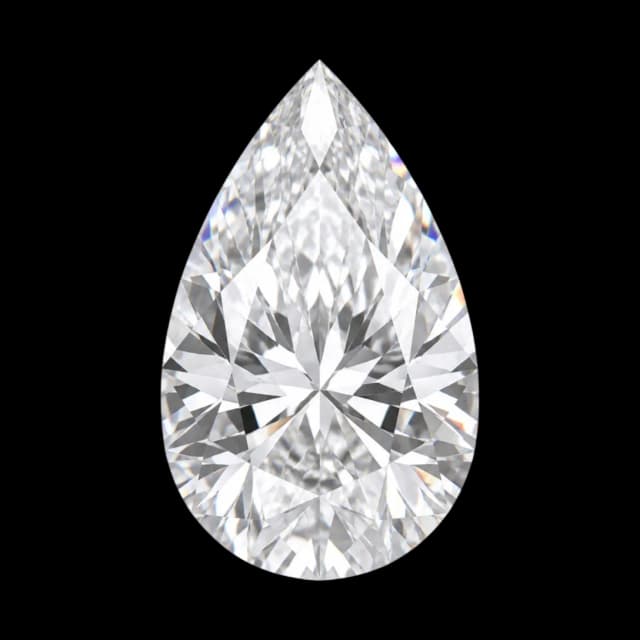
Pear Diamond
The pear shape (also called the teardrop) combines a rounded end with a single pointed tip, creating a unique silhouette that elongates the finger. It offers excellent brilliance and a larger face-up appearance than many shapes of equal carat weight.
Is a pear diamond a good choice?
Pear diamonds are known for very high brilliance with 58 facets. They're popular for engagement rings and pendants. Here are the trade-offs.
Why people love it
- +Appears significantly larger face-up than rounds of equal carat weight
- +Creates an elegant finger-lengthening effect when worn point-up
- +Very versatile. Works as a center stone, pendant, earring, or side stone
- +Strong brilliance approaching that of round brilliant
- +20-30% more affordable than comparable round brilliants
Things to know
- −Pointed tip is vulnerable to chipping if not protected by the setting
- −Bow-tie effect is common and must be evaluated visually
- −Symmetry issues are more apparent than in symmetrical shapes
- −Color can concentrate at the pointed tip, so you may need a higher color grade
How big is a pear diamond? (MM to carat)
A 1-carat pear diamond measures approximately 8.0 x 5.5 mm. Here are the most common sizes from 0.25 ct to 5 ct.
| Carat Weight | Size (mm) |
|---|---|
| 0.25 ct | 5.0 x 3.3 mm |
| 0.33 ct | 5.5 x 3.6 mm |
| 0.5 ct | 6.5 x 4.3 mm |
| 0.75 ct | 7.5 x 5.0 mm |
| 1 ct | 8.0 x 5.5 mm |
| 1.25 ct | 8.5 x 5.8 mm |
| 1.5 ct | 9.0 x 6.0 mm |
| 2 ct | 10.0 x 6.7 mm |
| 2.5 ct | 10.8 x 7.1 mm |
| 3 ct | 11.5 x 7.5 mm |
| 4 ct | 12.5 x 8.3 mm |
| 5 ct | 13.5 x 9.0 mm |
View full pear size chart → with all sizes from melee to 5+ carats.
How to buy a pear diamond
- •Always ensure the setting protects the pointed tip. A V-prong or bezel tip is essential
- •Symmetry is critical: both shoulders and wings should mirror each other precisely
- •Request video to evaluate bow-tie severity. A faint bow-tie is acceptable, a dark one is not
- •Color tends to concentrate at the tip, so consider staying at G or above in white metals
- •L/W ratios of 1.50-1.65 offer the most balanced classic teardrop shape
- •When worn as a ring, the traditional orientation is point facing the fingertip
- •Check that the rounded end is truly round, not flat or squared. This indicates poor cutting
What makes a pear diamond unique?
How much does a pear diamond cost?
Pear diamonds are priced at 20-30% less than round brilliant. Price depends on carat weight, color, clarity, and cut quality. For a personalized estimate, use our diamond price estimator.
Estimate pear diamond price →Technical Specifications
- Facets
- 58
- Brilliance
- very high
- L:W Ratio
- 1.45:1 to 1.75:1 (classic teardrop), with 1.50-1.65:1 most popular
Last updated: 2026-07-16
At a Glance
- Price vs Round
- 20-30% less than round brilliant
- Popularity
- Moderate popularity (approximately 4-6% of engagement ring sales)
- Sparkle
- very high
Best For
Setting Ideas
- Solitaire with a V-prong at the tip. Protects the point while maintaining clean lines
- Halo that follows the teardrop contour and adds perceived size
- Three-stone with smaller pears or round side stones
- Bezel at the tip with prongs at the round end for a hybrid approach
- Pendant setting (the classic orientation for pear-shaped diamonds)
- Cathedral setting with a V-prong tip for added protection and height