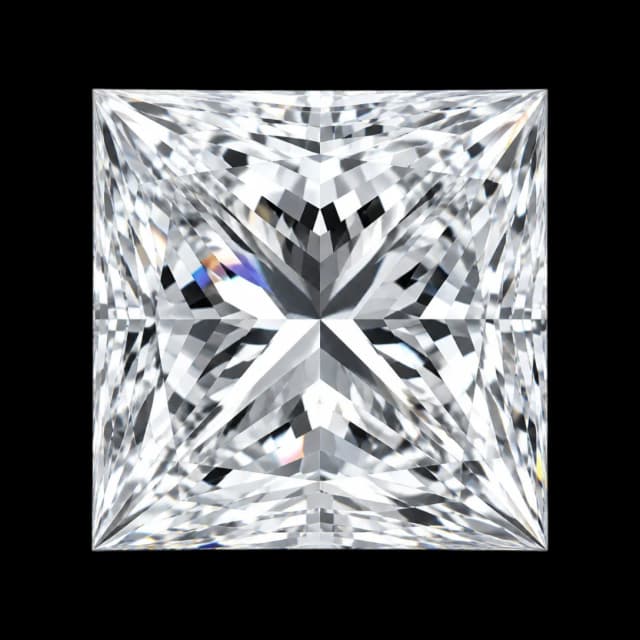
Princess Diamond
The princess cut is a square modified brilliant with sharp, uncut corners that deliver exceptional brilliance in a geometric silhouette. It's the most popular non-round shape and offers outstanding value, costing significantly less per carat than rounds.
Is a princess diamond a good choice?
Princess diamonds are known for very high brilliance with 57 facets. They're popular for engagement rings and channel-set bands. Here are the trade-offs.
Why people love it
- +Exceptional brilliance that rivals round brilliants in light performance
- +25-35% less expensive than comparable rounds
- +Clean, modern geometric lines that appeal to contemporary tastes
- +One of the most efficient shapes to cut, which keeps prices down
- +Strong brilliance hides inclusions well, allowing lower clarity grades
Things to know
- −Sharp corners are vulnerable to chipping and must be protected by the setting
- −Shows color more than rounds, so consider higher color grades in white metals
- −Square shape can appear smaller face-up than elongated shapes of equal weight
- −No standardized cut grade from GIA. You need to evaluate proportions independently.
How big is a princess diamond? (MM to carat)
A 1-carat princess diamond measures approximately 5.5 x 5.5 mm. Here are the most common sizes from 0.25 ct to 5 ct.
| Carat Weight | Size (mm) |
|---|---|
| 0.25 ct | 3.3 x 3.3 mm |
| 0.33 ct | 3.6 x 3.6 mm |
| 0.5 ct | 4.2 x 4.2 mm |
| 0.75 ct | 4.9 x 4.9 mm |
| 1 ct | 5.5 x 5.5 mm |
| 1.25 ct | 5.9 x 5.9 mm |
| 1.5 ct | 6.3 x 6.3 mm |
| 2 ct | 7.0 x 7.0 mm |
| 2.5 ct | 7.5 x 7.5 mm |
| 3 ct | 7.9 x 7.9 mm |
| 4 ct | 8.7 x 8.7 mm |
| 5 ct | 9.3 x 9.3 mm |
View full princess size chart → with all sizes from melee to 5+ carats.
How to buy a princess diamond
- •Corner protection is non-negotiable. Always choose a setting with V-prongs or bezel at the corners.
- •Look for stones with chevron facets visible through the table. This indicates proper brilliant-style cutting.
- •Keep L/W ratio between 1.00 and 1.05 for a true square appearance; anything over 1.10 will look rectangular
- •Princess cuts can tolerate SI1-SI2 clarity better than step cuts because the brilliant faceting hides inclusions
- •Color tends to concentrate in corners. Stay at H or above in white metals.
- •Check the depth percentage: 65-75% is optimal; stones shallower than 65% may look glassy
- •Inspect corners carefully. Even small chips from handling at the wholesale level should be flagged.
What makes a princess diamond unique?
How much does a princess diamond cost?
Princess diamonds are priced at 25-35% less than round brilliant. Price depends on carat weight, color, clarity, and cut quality. For a personalized estimate, use our diamond price estimator.
Estimate princess diamond price →Technical Specifications
- Facets
- 57
- Brilliance
- very high
- L:W Ratio
- 1.0:1 to 1.05:1 (square, most popular) or 1.05:1 to 1.20:1 (slightly rectangular)
Last updated: 2026-07-16
At a Glance
- Price vs Round
- 25-35% less than round brilliant
- Popularity
- Very popular (approximately 5-8% of engagement ring sales, second or third most popular shape)
- Sparkle
- very high
Best For
Setting Ideas
- Four-prong with V-prongs at all four corners (essential for chip protection)
- Channel setting. Ideal for side stones, eliminates corner exposure entirely.
- Bezel. Maximum corner protection with a sleek modern look.
- Halo. Softens the geometric look while adding perceived size.
- Three-stone with smaller princess or trillion side stones
- Invisible setting. Multiple princess cuts set together for a continuous diamond surface.