The Real Cost of Starting a Jewelry Business in 2026
A full breakdown of what it actually costs to start a jewelry business at three budget tiers. Equipment, inventory, marketing, legal, and what nobody warns you about.
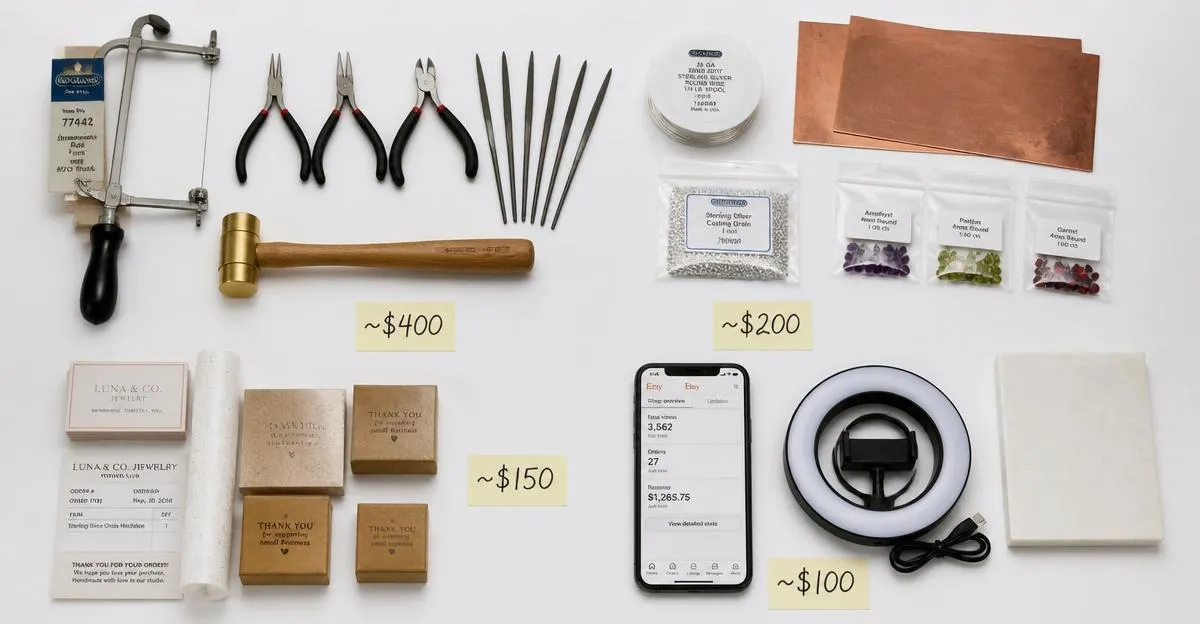
Somewhere between "I could do this as a hobby" and "I want to build a real business" is a gap made entirely of money. Knowing exactly how much money is what separates people who start from people who just think about starting.
So here it is. Three tiers, broken down to specific line items, based on what actually costs money in 2026.
Tier 1: Bootstrapped Start ($2,000-5,000)
This is the "I make jewelry at my kitchen table and sell on Etsy" tier. Not an insult. Plenty of successful businesses started here. But you need to understand the limitations.
Equipment ($800-2,000):
- Basic hand tools (pliers, files, saw frame, mandrel): $200-400
- Soldering setup (butane torch, soldering block, flux, solder): $150-250
- Finishing supplies (sandpaper, polishing compound, flex shaft or Dremel): $200-400
- Measuring tools (ring mandrel, digital scale, calipers): $100-150
- Storage and organization: $50-100
Initial materials ($500-1,500):
- Sterling silver wire and sheet (your starting metal, forgiving and affordable): $200-500
- Basic gemstone assortment (CZ, semi-precious cabochons): $100-300
- Findings (clasps, jump rings, ear wires, chains): $100-200
- Packaging (boxes, tissue, business cards): $100-200
Digital setup ($300-800):
- Etsy shop fees (listing fees + first month): $50
- Photography (DIY lightbox from Amazon): $40-80
- Website/domain (optional at this stage): $0-200
- Logo design (Fiverr or DIY): $0-100
- Basic social media setup: $0
- Business cards: $30-50
Legal basics ($200-500):
- Business registration (sole proprietorship): $50-200 depending on country/state
- Hallmarking registration (required in many EU countries): $100-300
- Basic insurance (optional but recommended): $30-50/month
What you can do at this level: Wire wrapping, basic fabrication, simple stone setting, chain assembly. Sterling silver and copper pieces selling for $30-150 retail.
What you can't do: Casting, working with gold (too expensive to waste while learning), diamond setting, CAD design.
Monthly operating cost at this tier: $200-500 (materials replenishment, Etsy fees, packaging).
Tier 2: Serious Small Business ($10,000-25,000)
This is "I've decided to do this for real" territory. You're working with gold, you have proper equipment, and you're selling at prices that can actually sustain a living.
Equipment ($4,000-10,000):
- Professional flex shaft motor (Foredom or similar): $400-600
- Soldering station upgrade (oxy-acetylene or hydrogen torch for gold): $500-800
- Polishing motor with proper dust collection: $400-700
- Small kiln (for annealing, burnout, or enameling): $500-1,200
- Microscope or high-quality magnification: $200-500
- Casting setup basic (wax tools, injector, small vacuum caster): $2,000-4,000
- Laser welder (optional but game-changing for repairs and assembly): $3,000-8,000
- Bench, chair, proper lighting: $500-1,000
Materials and inventory ($3,000-8,000):
- Gold stock (14K wire, sheet, casting grain): $2,000-5,000
- Silver stock: $300-500
- Gemstone inventory (diamonds, colored stones): $1,000-3,000
- Mountings and settings (pre-made, to customize): $500-1,000
- Consumables (burs, blades, flux, investment, pickle): $200-400
Digital infrastructure ($1,500-4,000):
- Professional photography setup (proper lights, background, camera or high-end phone): $500-1,500
- Shopify or similar e-commerce ($39-79/month = $500-1,000/year): $500-1,000
- CAD software (Rhino + MatrixGold license): $1,000-2,500
- Accounting software: $150-300/year
- Email marketing platform: $0-300/year
Marketing ($1,000-3,000 initial):
- Social media content creation (templates, scheduling tools): $200-400
- Initial advertising budget (Instagram/Pinterest ads, test period): $500-1,500
- Market research and SEO setup: $200-500
- Brand photography (if not DIY): $300-800
Legal and professional ($500-2,000):
- Business entity formation (LLC/Ltd): $200-500
- Proper insurance (workshop + product liability): $500-1,200/year
- Bookkeeper (quarterly): $300-600
- Hallmarking and assay office registration: $100-300
What this level enables: Custom gold work, basic casting, diamond setting, professional e-commerce presence, and prices of $200-2,000+ per piece.
Monthly operating cost: $1,500-4,000 (rent if applicable, materials, marketing, subscriptions, insurance).
Tier 3: Full Production Operation ($40,000-100,000+)
This is a manufacturing business. You're producing at volume, employing people or outsourcing production, and competing with established brands.
Production equipment ($15,000-40,000):
- Professional casting machine (vacuum, high-capacity): $5,000-12,000
- Burnout kiln (programmable, multi-flask): $2,000-4,000
- 3D printer for wax/resin (Solidscape or Formlabs): $3,000-10,000
- CNC mill or advanced finishing equipment: $5,000-15,000
- Full polishing department (tumbler, electro-polishing, ultrasonic): $2,000-5,000
- Quality control station (digital microscope, measurement tools): $1,000-3,000
Inventory and materials ($10,000-30,000):
- Gold inventory (multiple karats, colors): $5,000-15,000
- Diamond inventory (melee, calibrated stones): $3,000-10,000
- Colored stone inventory: $2,000-5,000
- Mounting and component stock: $2,000-5,000
Workspace ($5,000-15,000 setup):
- Workshop build-out (ventilation, electrical, plumbing): $3,000-10,000
- Security (safe, alarm system, cameras): $2,000-5,000
- First/last month rent deposit: variable
Staff ($0-50,000/year per person):
- Production assistant: $30,000-45,000/year
- Part-time admin/shipping: $15,000-25,000/year
- Commission sales rep: variable
Technology ($3,000-8,000):
- ERP or inventory management system: $1,000-3,000/year
- Professional e-commerce with custom development: $2,000-5,000
- Professional photography and videography: $1,000-3,000 initial
Monthly operating at this tier: $8,000-25,000+
What Nobody Warns You About
The equipment costs are the easy part to plan for. Here's what catches people off guard:
Scrap and material losses. When you're learning, expect to ruin 10-20% of your gold through filing too aggressively, failed castings, and practice mistakes. On a $50 piece of silver, this stings. On a $400 piece of gold, it hurts.
Time is the real cost. A piece that takes you 6 hours to make and sells for $300 sounds profitable until you do the math. $300 minus $100 materials = $200. Divided by 6 hours = $33/hour before overhead. And that's if it sells immediately, which it won't.
Inventory sits. Not everything you make sells quickly. Some pieces take months. Your money is locked in metal and stones sitting in a display case. Cash flow is a bigger killer than material costs.
Seasonal demand. Jewelry sales spike November-February (holidays, Valentine's, engagements) and drop March-September. Plan your cash reserves around this.
Returns and remakes. Budget 5-10% of revenue for pieces that come back, need resizing, or need remaking because the customer changed their mind. It's the cost of doing business.
Photography takes forever. Seriously. If you plan to sell online, budget 30-60 minutes per piece for proper product photography. That's unpaid time that adds up fast when you have 50 SKUs.
The Decision Framework
Don't pick a tier based on what you can afford today. Pick it based on where you want to be in 12 months, and build toward it.
Starting at Tier 1? Great. Set aside 20% of every sale toward Tier 2 equipment. Within 6-12 months of consistent selling, you'll have enough to upgrade.
Jumping straight to Tier 2? Make sure you have 6 months of living expenses saved separately. The business won't be profitable for at least 6 months, probably 12.
Going all-in at Tier 3? You need either significant savings, investors, or an existing client base that guarantees revenue from day one.
Track Your Numbers
Use our pricing calculator to model your prices at different cost structures. It'll show you exactly what you need to charge to hit your income goals at each tier.
And whatever you do: separate your business account from personal. From day one. Even if it's "just a hobby right now." The moment money gets mixed, you lose visibility into whether the business actually works.
The most expensive mistake in starting a jewelry business isn't buying the wrong torch. It's not knowing your numbers.