Jewelry Pricing Formula: How to Calculate Material + Labor + Markup
The actual formula jewelers use to price their work. Material costs, labor rates, overhead, and why most beginners underprice by 40%.
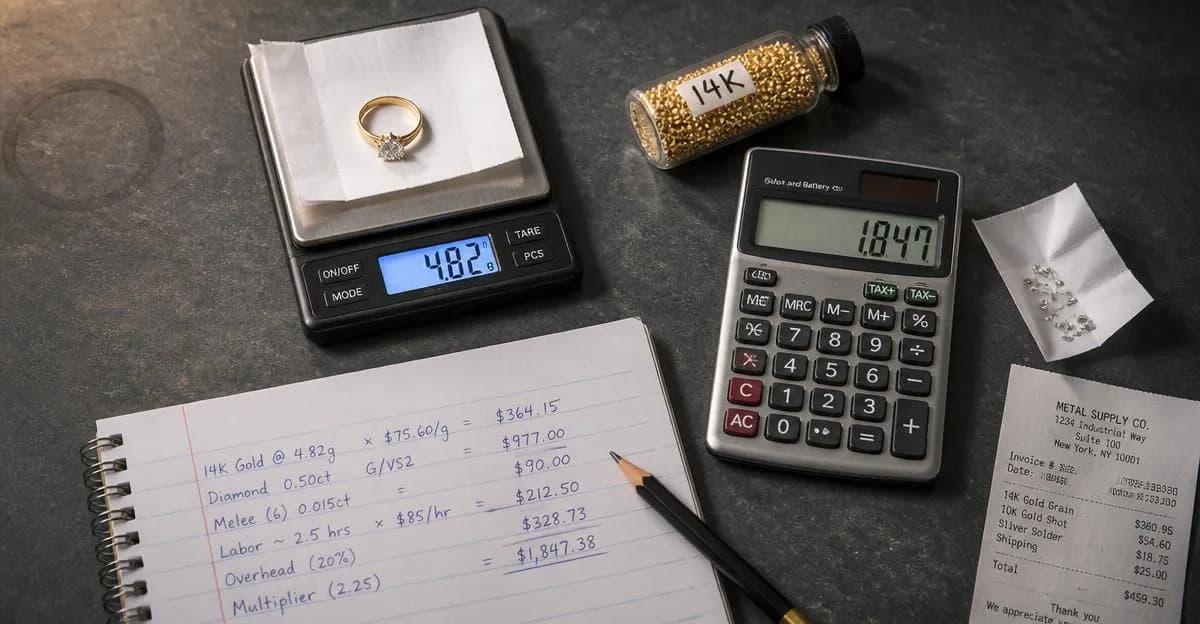
Most jewelers price their work wrong. They calculate material cost, add a little for their time, and call it done. Then they wonder why they're working 60-hour weeks and barely breaking even.
The problem is almost always the same: they forgot overhead. Or they undervalued their labor. Or both.
Here's the formula that actually works.
The Core Formula
Retail Price = (Material Cost + Labor Cost + Overhead) × Markup Multiplier
That's it. Four components. But each one has depth that trips people up.
Component 1: Material Cost
This is the most straightforward part. Weigh your metal, multiply by the per-gram cost at current spot price, adjust for karat purity.
For gold:
- Check the live spot price (use our gold price tracker)
- Calculate pure gold content: weight in grams × karat percentage (14K = 58.3%, 18K = 75%)
- Multiply pure gold content by spot price per gram
- Add 10-20% for alloy metals and refining losses
Example: A 14K ring weighing 5 grams.
- Pure gold content: 5g × 0.583 = 2.915g of gold
- At $75/gram spot: 2.915 × $75 = $218.63
- With 15% alloy/loss buffer: $251.42
For gemstones, use your actual purchase cost. Not what you think they're worth. What you paid.
One mistake I see constantly: people forget to account for material waste. When you saw, file, and polish a piece, you lose material. For rings, expect 5-10% waste. For complex fabricated pieces, it can hit 15-20%. Build this into your material cost.
Component 2: Labor Cost
This is where most jewelers underprice themselves. You need two numbers:
- Your hourly shop rate
- Actual time spent per piece (including setup, cleanup, mistakes)
Your hourly rate should not be your "salary divided by hours worked." It needs to be a rate that covers your skilled labor at market value.
Benchmarks for 2026:
- Beginning jeweler/student: $25-40/hour
- Competent production jeweler: $50-75/hour
- Master goldsmith (custom work): $100-200/hour
- Specialist (engraving, stone setting): $75-150/hour
Be honest about time. That ring you "made in two hours"? Did you count design time? The time selecting stones? The trip to the supplier? Setting up and breaking down? Packaging?
Most handmade jewelry takes 2-5x longer than makers estimate. Track your actual time for a month. The numbers will surprise you. And not in a good way.
Component 3: Overhead
This is what kills small jewelry businesses. Overhead is everything that costs money but isn't material or direct labor:
- Rent/workspace ($200-2000/month depending on location)
- Tools and equipment depreciation (spread cost over lifespan)
- Insurance
- Website, photography, packaging
- Marketing and advertising
- Software (CAD licenses, accounting, etc.)
- Utilities
- Continuing education
How to calculate your overhead rate: take your total monthly overhead, divide by the number of pieces you produce per month. That's your per-piece overhead allocation.
Example: $3,000/month overhead, producing 40 pieces per month = $75 overhead per piece.
Or express it as a percentage of labor: if overhead equals your labor cost, use a 2x labor multiplier.
Component 4: Markup Multiplier
Here's where strategy enters the equation. Your multiplier depends on your market position and sales channel:
- Wholesale to retailers: 2x total cost (keystone markup)
- Direct-to-consumer, online: 2.5-3.5x total cost
- Retail store, mid-market: 3-4x total cost
- Luxury/designer positioning: 4-8x total cost
- Fine jewelry (branded): 5-10x+ total cost
The multiplier accounts for: marketing cost to acquire customers, returns and remakes, inventory that doesn't sell, and your profit margin.
Here's something nobody tells beginners: a 2x multiplier on a piece that took you 4 hours means you're actually making very little once you subtract your hourly rate. The multiplier needs to be high enough that your effective hourly take-home after expenses exceeds what you'd earn working for someone else.
Putting It All Together
Let's price a custom 14K gold solitaire ring with a 0.5ct diamond:
Materials:
- 14K gold, 6 grams: $302 (including waste buffer)
- 0.5ct diamond (purchased at wholesale): $800
- Findings and consumables: $15
- Total materials: $1,117
Labor:
- Design consultation: 1 hour
- CAD work: 2 hours
- Casting and finishing: 3 hours
- Stone setting: 1 hour
- Quality check and packaging: 0.5 hours
- Total: 7.5 hours × $75/hour = $562.50
Overhead: $75 per piece = $75
Total cost: $1,754.50
Retail price (3x multiplier, direct-to-consumer): $5,263.50
Round it: $5,250.
Sounds expensive? That diamond cost $800 wholesale. You spent nearly a full working day on the piece. And after the 3x multiplier accounts for marketing, returns, and slow months, your actual profit is roughly $1,800. For 7.5 hours of skilled labor plus all the non-billable time around it.
Why Beginners Underprice
Four reasons, always:
- They compare to mass-produced jewelry (unfair comparison; factory amortizes equipment across 10,000+ pieces)
- They feel guilty charging "that much" (get over it or stay broke)
- They skip overhead entirely (which means their profit is actually zero or negative)
- They calculate labor at minimum wage instead of skilled-trade rates
Look, a plumber charges $120/hour. An electrician charges $90-150. You're working with precious metals, gemstones, and fire. Your rate should reflect your skill level and the risk involved.
The "Would I Do This for Someone Else" Test
Calculate your per-piece profit after all costs. Divide by hours spent (including admin, photo, listing time). If that number is less than what you'd earn working for another jeweler or in a completely different field, your pricing is wrong.
In my experience, the sweet spot for sustainable one-person jewelry businesses is pricing finished pieces at 3.5-4x total cost when selling direct. It gives you enough margin to absorb slow months, cover mistakes, and actually build savings.
Common Pricing Models by Segment
Production/manufacturing (wholesale): Cost + 100% (2x). You make it up in volume. 50+ pieces per design minimum.
Custom/bespoke: Hourly rate × time + materials × 1.5-2x. The multiplier is lower because you're charging adequate hourly rates.
Artist/designer brand: Emotion-based pricing. Your pieces sell based on brand and design, not cost calculation. Price by what the market will bear, with floor at 3x cost.
Tools That Help
Use our pricing calculator to run these numbers quickly. Input your metal weight, labor hours, and overhead, and it gives you price points across different multipliers.
The scrap calculator helps verify your material costs against current spot price.
And track everything in a spreadsheet. Every piece, every hour, every material purchase. After three months, you'll see your real numbers clearly. Most people are shocked.